Freedom
حرية
Hurriya · Camel's Eye · Be'er Sheva & Negev
書籍の本文は英語とアラビア語で掲載しています。全文の日本語訳は今後公開予定です。
動画
コンセプト
Freedom (Hurriya) is not the absence of all constraint — it is the capacity to move according to one's own nature and purpose. The Negev Bedouin understood freedom as mobility: the ability to cross the most forbidding landscape without being diminished by it, to carry everything one needs, to be at home wherever one stops.
الحرية ليست غياب كل قيد — بل القدرة على التحرك وفق طبيعة المرء. فهم بدو النقب الحرية كحركة: القدرة على عبور أكثر التضاريس قسوةً دون أن تُقّلك.
模様について
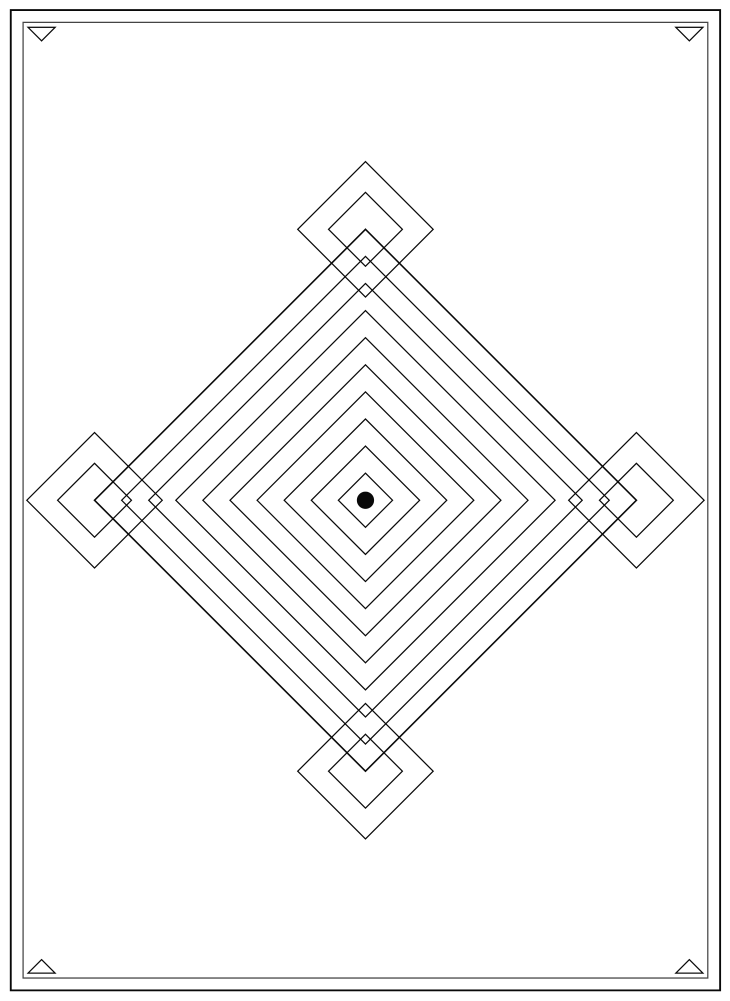
The Camel's Eye sees what ordinary eyes cannot — the patient, deep-seeing gaze of the creature that survives the most forbidding terrain. Each diamond nested inside the next, smaller as it approaches the center: this is the geometry of Hurriya as the Negev Bedouin understood it. Freedom is not the open horizon alone; it is the inner stillness that makes crossing any terrain possible. The center of the Camel's Eye is the freest point: the still core from which all movement originates.
عين الجمل ترى ما لا تراه العيون العادية — النظرة الصابرة العميقة للمخلوق الذي ينجو من أكثر التضاريس قسوةً. كل معين متداخل داخل التالي، أصغر كلما اقترب من المركز: هندسة الحرية كما فهمها بدو النقب.
この模様は書籍の38ページで塗ることができます。
塗り方ガイド
Start from the outermost diamond
Fill the largest diamond first — your lightest color.
Work inward, darkening each ring
Each successively smaller diamond gets slightly darker — build toward center.
Add the four surrounding large diamonds
The four cardinal diamonds around the composition — same palette, full saturation.
Fill the inner diamonds of each
Each outer diamond has its own inner form — accent color.
Complete the center point
The solid filled center dot — your deepest, darkest point.
おすすめの配色
#b8860b#daa520#f5f0e8#0a0a0a
文化的な背景
The Camel's Eye (Ain al-Jamal) is documented primarily from the Be'er Sheva and Negev Bedouin tradition. The Bedouin Palestinians of the Negev maintained large camel herds as the primary infrastructure of desert life — transport, trade, and survival. The camel's deep-set, patient, far-seeing eye became an emblem of the desert intelligence that made this life possible.
Bedouin Tatreez from the Negev region differs markedly from settled-village embroidery in its palette and its motif selection. The Bedouin palette is brighter and more varied — reflecting trade connections across the caravan routes and the exchange of dyes from distant markets. The Camel's Eye uses yellows, rich browns, and deep reds that reflect the desert landscape and the animal that navigates it.
After 1948, the Negev Bedouin were subjected to a series of forced transfers and land confiscations that disrupted their traditional semi-nomadic way of life. Their embroidery traditions — including the Camel's Eye — were carried into the refugee communities of Gaza, the West Bank, and the diaspora. The pattern has survived because it was transmitted; it was transmitted because it was understood to carry something irreplaceable.
振り返り
What does freedom mean to you — not as an abstract ideal but as a lived, daily experience?
書籍の40ページに答えを書いてください。